Army Spokesperson: U.S. Must Pay the Costs and Exit the Region

WANA (Sep 04) – Iranian military officials reported that armed forces launched missiles and unmanned aerial vehicles at regional U.S. installations within fifteen minutes of a second major U.S. aggression against the country’s southern border region since the ceasefire.
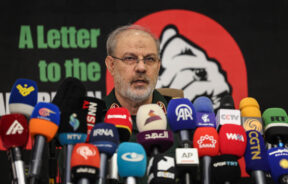
Speaking in a live television broadcast, Iranian Army Spokesperson Brigadier General Mohammad Akraminia detailed the operational counter-strikes executed by both the regular army and the Islamic Revolutionary Guard Corps (IRGC).
According to General Akraminia, the initial U.S. aggression occurred on July 7, lasting approximately two weeks, while the latest strikes took place on August 30. He asserted that the primary objective behind these operations was to undermine or dismantle Iranian control over the Strait of Hormuz and disrupt the sovereign maritime measures currently being finalized in the area.
Describing the operational structure of the response, Akraminia highlighted its rapid deployment, heavy volume of fire, and broad geographical scope spanning from Jordan to the United Arab Emirates.
Armed forces targeted four American bases across three neighboring countries: two facilities in the United Arab Emirates, the Sheikh Isa Air Base in Bahrain, and a base in Kuwait. Subsequent field assessments and satellite intelligence confirmed severe structural damage to the targeted sites.
The operation utilized domestic “Fath” surface-to-surface missiles alongside “Arash-2” loitering munitions. Both platforms were integrated with artificial intelligence systems and updated guidance technology to bypass air defense networks. Akraminia noted that forces applied asymmetric warfare models and combined tactical maneuvers learned during prior 12-day and 40-day conflict phases.
The spokesperson stated that these latest strikes were executed under phases 29, 30, and 31 of Operation Sa’eqeh. Phases 29 and 30 were launched immediately following the August 30 aggression, while phase 31 was conducted two nights prior to fulfill deterrence objectives and complete targeted operational goals.
Akraminia highlighted that Iran’s military doctrine has systematically shifted toward preemptive operations under international legal frameworks for self-defense. He cited the pivotal role of the late General Mousavi during his tenure heading the Armed Forces General Staff in establishing this offensive doctrine.
Preemptive actions have already targeted U.S. positions in Jordan, Syria, and the Iraqi Kurdistan region, effectively neutralizing anti-government separatist forces before ground operations could be initiated against Iranian borders.
Addressing logistical impacts, Akraminia stated that damage to key U.S. support bases, particularly in Bahrain, has caused severe supply disruptions for U.S. personnel and naval vessels, forcing military supply lines to rely on distant hubs such as Diego Garcia and East Asia.
He added that domestic economic pressure in the United States, including rising fuel prices, is a direct fallout of Washington’s regional military aggression. Regarding future posture, Akraminia asserted that the destruction of U.S. radar and air defense systems in the region has cleared flight paths toward targets in the occupied territories, warning that any Israeli participation or aggression would meet a far swifter and more crushing response.
Concurrently, Akraminia characterized Washington’s calls for civil unrest in Iran and its reliance on reinstated economic sanctions following the 40-day war as indicators of “strategic desperation.”
He concluded that Iran remains firmly committed to exercising its sovereignty over the Strait of Hormuz and managing maritime traffic, maintaining that regional security will only be realized once U.S. forces completely withdraw from the region.
Reiterating these points in a subsequent written statement, Brigadier General Akraminia emphasized that the difficulties facing the U.S. military in the region and the economic hardships experienced by the American public stem directly from errors made by U.S. leadership in attacking an independent and civilized nation.
He stated that the proper path forward for Washington requires accepting on-ground realities, covering the associated costs, and carrying out a complete troop withdrawal, which he asserted would make the region safer and bring greater stability to the American people.