

Baghaei: No Hormuz Deal Without End to US Naval Blockade

WANA (Nov 02) – Iranian Foreign Ministry Spokesman Esmaeil Baghaei said the United States must meet Iran’s legitimate demands, including lifting its naval blockade, to restore security in the Strait of Hormuz and allow negotiations to move forward, stressing that diplomatic exchanges between Tehran and Washington are continuing through intermediaries.
Speaking at his weekly press conference on Monday, Baghaei said Iran had already communicated its legitimate demands to the United States and that fulfilling them was a prerequisite for restoring security in the Strait of Hormuz.
He stressed that no final agreement could be reached and the Strait of Hormuz could not be reopened and secured unless the US naval blockade was lifted, Iran’s demands were respected, and its legitimate requests were implemented.
Baghaei added that security could not be established unilaterally in the Strait of Hormuz and the Persian Gulf without an end to the economic blockade and compliance with commitments, emphasizing that Washington needed to decide how it intended to proceed.
Iran’s Seven-Point Initiative Remains Basis for Diplomatic Exchanges
The spokesman said Iran’s diplomatic initiative, referred to as the seven-day plan, had been discussed in detail during the visit of the Iranian delegation to New York. He noted that Tehran had received the other side’s views through mediators and that various considerations had been exchanged.
Baghaei said Iran’s proposal remained on the table and that the ball is now in Washington’s court, as Tehran has clearly and transparently presented its demands.
He explained that diplomatic exchanges between Iran and the United States through intermediaries were currently based on Iran’s seven-point plan, adding that the proposal could even be implemented within two days.
He described Iran’s approach as a demonstration of goodwill, noting that Tehran had indicated that security could be restored to the Strait of Hormuz within a short period and negotiations could begin if its demands were met. He emphasized, however, that the next steps depended on Washington’s decisions.
Iran-US Talks Continue Through Intermediaries
Asked about the recent visit by Deputy Foreign Minister Kazem Gharibabadi to Doha and whether negotiations were continuing, Baghaei confirmed that diplomatic exchanges were ongoing.
He explained that Gharibabadi’s visit to Doha had been intended to facilitate the negotiations, noting that the issues under discussion were complex and that developments over time, particularly as a result of US actions, had further complicated matters.
Baghaei also confirmed that messages were still being exchanged between the two sides, reiterating that Iran had already conveyed its legitimate demands to the United States.
Iran’s Negotiating Team Remains Unchanged
Asked whether Iran had changed its negotiating team, Baghaei said no changes had been made.

He referred to remarks made by Mohsen Rezaei, Secretary of the Supreme National Security Council (SNSC), on Saturday, explaining that the council was responsible for managing and making decisions on the matter under the chairmanship of the president, with the Foreign Ministry and other state institutions also represented.
He said Mohammad Bagher Ghalibaf and the foreign minister remained Iran’s senior negotiators, adding that there was a good level of unity and coordination among the country’s decision-making bodies.
Iran Will Judge US by Its Actions, Not the Tone of Its Letters
Commenting on reports about a letter from US Vice President JD Vance to Mohsen Rezaei, including claims that its tone differed from previous correspondence, Baghaei said variations in writing styles were normal, as different individuals could express themselves in different ways. He stressed that what mattered to Iran was the performance of the US government.
Baghaei said Washington had so far demonstrated no diplomatic initiative and had instead undermined diplomatic efforts. He noted that over the past two years, the United States had consistently pursued a path of war, disrupting diplomatic processes either while they were underway or after they had produced results.
As an example, he referred to the Islamabad understanding, which he said had been violated two or three weeks after it was reached. The spokesman noted that the person who had negotiated the Islamabad process was the same individual who had written the letter, adding that the US president had recently described that process as a waste of time.
In light of this record, Baghaei said any diplomatic process should be approached with considerable caution.
Regarding whether Iran would respond to Vance’s letter, he explained that since Rezaei was its recipient, the SNSC secretary would decide on the appropriate course of action.

What Lies Behind U.S. Media Campaign Over Vance’s Letter to Mohsen Rezaei?
WANA (Oct 30) – An international affairs expert says the Trump administration and U.S. media outlets are seeking to shape public opinion over a confidential letter from Vice President JD Vance to Mohsen Rezaei, secretary of Iran’s Supreme National Security Council, even though its contents have not been officially disclosed. An international affairs expert, […]
He added that the letter had not introduced a new diplomatic initiative, emphasizing that the existing framework for exchanges between Iran and the United States remained the seven-point Iranian proposal.
Baghaei: Israeli Regime Remains Root Cause of Regional Problems
At the beginning of the press conference, Baghaei addressed the latest developments in West Asia, saying the Israeli regime continued its genocide in Palestine.
He described the Israeli regime as the root cause of the region’s problems, adding that its crimes had intensified following the regime’s elections.
Baghaei Says Contradictory US Messages Reflect Confusion in Washington
Asked whether the contrasting messages coming from the US administration, including President Donald Trump’s threats against Iran and Vance’s letter to Rezaei, could be considered part of a deception operation, Baghaei said such a possibility could not be ruled out.
However, he stressed that deception involved both a party attempting to mislead and another being misled, adding that Iran would not fall for such tactics.
He said Iran was not inexperienced in dealing with American officials and had not forgotten that the US president had announced on social media that negotiations with Iran were continuing just half an hour before the military aggression in June of last year.
Baghaei said Tehran was taking into account its understanding of developments over the past two years, as well as its earlier experiences in 2015 and 2018.

War Threats and Diplomatic Maneuvering in Tehran: Critical Days Ahead for Iran
WANA (Oct 26) – As diplomatic exchanges between Iran and regional countries intensify, assessments point to a further escalation in military threats against Iran in the coming days. While efforts continue to prevent tensions from escalating and to examine regional proposals, some assessments suggest the possibility of coordinated action against Iran by the United […]
He acknowledged that different voices could exist within the US administration, some of which might reflect growing public demands for an independent American approach to developments in the Middle East.
He noted that American society had become frustrated and angry over what he described as the Israeli regime’s exploitative relationship with the United States, pointing to public opinion polls and demonstrations across the country as evidence.
Baghaei said it was not unlikely that some members of the US administration had come to recognize, even if they did not publicly acknowledge it, that Washington was sacrificing its credibility, wealth and international standing for a party whose only apparent priority was perpetuating war in the region.
He added that the Israeli regime had demonstrated that it considered its continued existence dependent on war and bloodshed in the region.
While acknowledging the possibility of differing positions within the US administration, Baghaei reiterated that Iran would judge Washington by its actions.
He said the contradictory messages not only reflected confusion within the US administration but also left the international community uncertain about who actually made decisions in Washington and whom other countries should engage with diplomatically.
He also raised questions about whether all decision-making channels ultimately led to Tel Aviv, saying the United States needed to address the issue if it wanted to preserve its credibility and international standing.
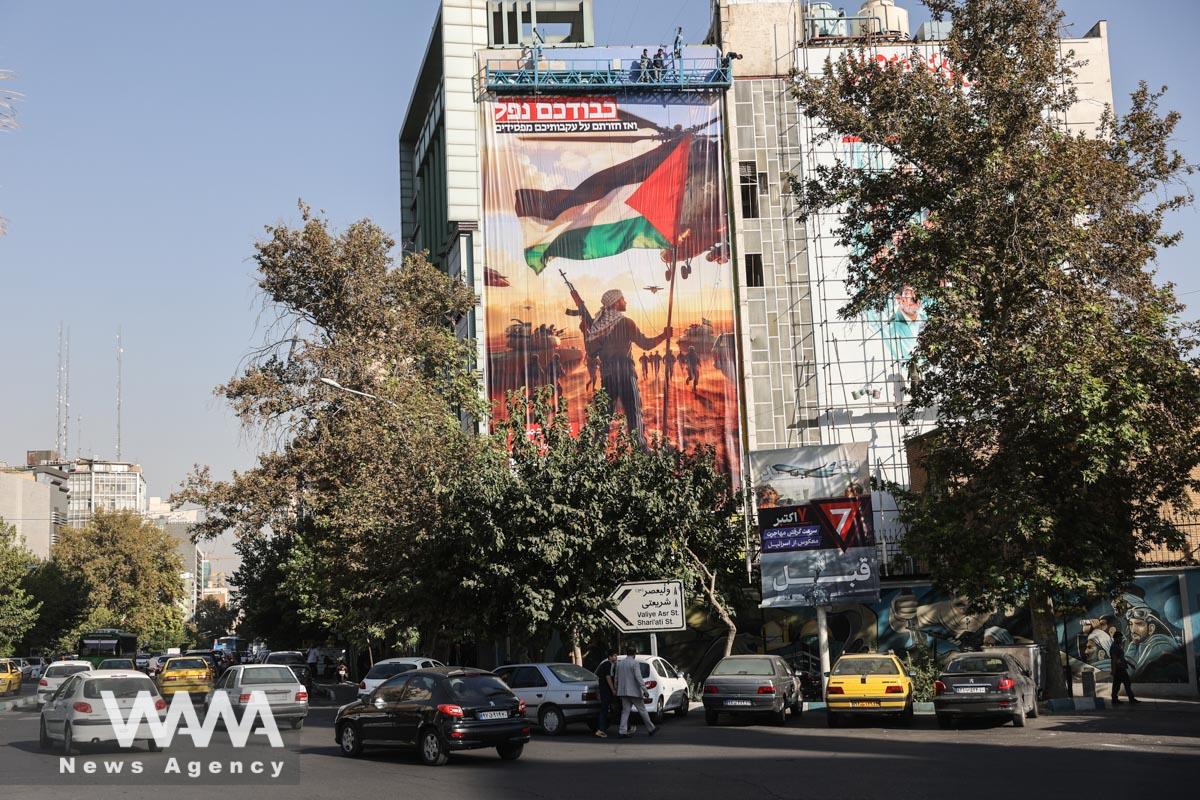
A pro-Palestine billboard is displayed on a street in Tehran, Iran, October 14, 2025. Majid Asgaripour/WANA (West Asia News Agency)
Baghaei Warns of Catastrophic Conditions for Displaced Palestinians Ahead of Winter
Addressing developments in Palestine, Baghaei said Israeli crimes against Gaza and Lebanon had intensified following the Israeli regime’s elections.
He noted that more than 10 Palestinians had been killed in Israeli attacks just the previous day, while conditions for displaced Palestinians in Gaza were becoming catastrophic as the cold season and winter approached.
He said Israel was even preventing the entry of mobile housing units and basic necessities for Palestinians, while European countries and the international community had become largely numb to the ongoing crimes.
Baghaei warned that the normalization of crimes and killings was an extremely dangerous development, particularly as Palestinians were increasingly reduced to statistics. He stressed that every life lost represented the destruction of an individual human life.
He said the United Nations and regional and international organizations, particularly the Organization of Islamic Cooperation (OIC), had a responsibility to take a position against these crimes.
Referring to a recent report by the UN Independent International Commission of Inquiry, Baghaei said it had documented part of the ongoing atrocities and demonstrated that genocide in Palestine was continuing on a severe scale, both in Gaza and the West Bank.
He also noted that Israeli officials were facing prosecution while the International Criminal Court was simultaneously under intense pressure from the United States, solely because it had attempted to pursue those responsible for crimes in accordance with its statute.

Jews After October 7: The Iranian Exception
WANA (Jun 16) – After the October 7, 2023, attack and Israel’s bloody response in Gaza, tensions spread beyond the Middle East, and a new wave of anti-Semitism and anti-Zionism swept through the streets and universities of both the West and the East. Protests that began with the slogan “Ceasefire” soon took on a […]
Baghaei Rejects European Allegations of Anti-Semitism Against Iran
Responding to recent allegations by several European countries, including Germany and the United Kingdom, as well as Australia, that Iran had planned attacks targeting Jewish individuals and property in those countries, Baghaei rejected the accusations, saying anti-Semitism had no connection to Iran or Iranian society.
He described anti-Semitism as a European phenomenon and said it was incompatible with Iranian religion, traditions, culture and civilization.
Baghaei said stereotypical accusations against Iran were repeatedly circulated and, unfortunately, promoted by the media, arguing that even a basic examination of the facts would show that Iranians had historically been among the most tolerant people toward Jews.
He pointed to the existence of 13 or 14 Jewish synagogues in the city of Yazd alone and approximately 100 across Iran, as well as the presence of the tombs of Jewish prophets and prominent religious figures throughout the country.
He also questioned how many attacks had been carried out against Jewish holy sites in Iran despite the country’s ongoing full-scale war with a regime that, according to him, falsely claimed to represent Jewish people. He said that any rare incidents had been dealt with immediately.
The spokesman called on European countries to compare the situation in Iran with developments in their own societies, questioning why Jewish cemeteries were repeatedly subjected to attacks in Europe and why synagogues in European capitals had to be surrounded by barbed wire or have their signs removed to protect them from potential attacks.
He argued that European countries were attempting to shift responsibility for their own problems onto others and should examine the social and cultural conditions that had led to such incidents.

Israel Strikes Jewish Synagogue in Tehran
WANA (Apr 07) – An Israeli-U.S. missile strike targeted central Tehran several hours ago, resulting in the destruction of a Jewish synagogue and a residential building near Taleghani Street. Emergency responders are currently on the scene, working frantically to rescue individuals trapped beneath the debris of the place of worship. Casualties and Structural […]
Baghaei added that some of these developments in Europe were linked to the crimes committed by the Israeli regime, which continually associated itself with Judaism.
He stressed that the Iranian people were sufficiently aware and civilized not to attribute the actions of a regime responsible for genocide to followers of the Jewish faith.
Regional Countries Must Not Allow Their Territory to Be Used Against Iran
Addressing relations with the United Arab Emirates (UAE), Foreign Ministry Spokesman Esmaeil Baghaei said Iran had not undermined trust between the two countries, arguing that regional states needed to reconsider their past approaches and prevent their territories and facilities from being used for hostile actions against Iran.
Commenting on remarks by an adviser to the UAE president about the erosion of trust between Tehran and Abu Dhabi, Baghaei said Iran could not remain silent in the face of the use of certain regional countries’ territories to violate its national sovereignty and target its people.
He said developments over the past eight months had resulted from some regional countries placing excessive trust in the US military presence on their soil. He added that some of these countries had not only failed to prevent the United States from using their facilities to carry out attacks against Iran but had also encouraged such actions.
Baghaei stressed that trust required reciprocal actions, reiterating that Iran had no hostility toward any country in the region and believed that regional states needed to cooperate and build mutual trust to establish lasting security.
He described it as a reasonable expectation for Iran that regional countries would not allow their territories and facilities to be exploited to attack a major country in the region.

Regional Crises Have No Military Solution; U.S. and Israeli Aggression Drive Persian Gulf Insecurity
WANA (Oct 19) – On Monday, Foreign Minister Seyed Abbas Araghchi met with Russian Foreign Minister Sergey Lavrov in Tehran for a high-level meeting and joint press conference, where he declared that European nations are partners in the recent U.S. war against Iran and emphasized that regional issues have no military solutions, requiring resolution through […]
Baghaei Rejects Allegations Against Iranian Nationals in Kuwait
Asked about the sentencing of several Kuwaiti nationals and an Iranian citizen on allegations of intelligence cooperation with Iran and an attempt to assassinate Kuwaiti officials, Baghaei categorically rejected the accusations, noting that the Iranian Embassy had already issued a statement on the matter.
He called on the Kuwaiti government to stop harassing its own citizens under the pretext of their sympathy and solidarity with Iran.
Baghaei said allegations against Iran and Iranian nationals over the past one or two years, particularly in recent months, had been entirely baseless and amounted to the repetition of stereotypes against the country.
He reiterated that Iran remained committed to the principles of good neighborliness and respect for the national sovereignty and territorial integrity of other countries.
Referring to similar measures in other regional countries, including Bahrain, he expressed concern over what he described as actions that violated fundamental human rights standards and further undermined the principle of good neighborliness.
Iranian Foreign Minister’s Visit to Turkmenistan Focuses on Economic Cooperation
Regarding the Iranian Foreign Minister’s visit to Turkmenistan and the economic issues on the agenda, Baghaei said the delegation included the deputy foreign minister for economic diplomacy as well as representatives from other relevant economic bodies, including the Ministry of Petroleum.
He described relations with neighboring countries as strategic for Iran, noting that its neighbors constituted an important geographical and geopolitical advantage.

Araghchi Meets Turkmenistan’s Foreign Minister in Ashgabat
WANA (Nov 02) – Iranian Foreign Minister Abbas Araghchi met with Turkmenistan’s Deputy Chairman of the Cabinet of Ministers and Foreign Minister Rashid Meredov during an official visit to Turkmenistan, holding talks on expanding bilateral cooperation and regional and international developments. Araghchi arrived in Ashgabat, the Turkmen capital, on Monday morning, November 2, leading […]
Baghaei said relations with neighboring states had steadily improved in recent years under Iran’s neighborhood policy, including ties with Turkmenistan and other countries in Central Asia and the Caucasus.
He explained that the visit was taking place within the framework of bilateral engagement and would cover cooperation in various fields, particularly economic, trade and energy relations.
Baghaei expressed hope that the visit would contribute effectively to improving economic exchanges between Iran and Turkmenistan.
Iran Documenting US Threats Against Its Nuclear Facilities
Asked about Iran’s legal efforts in response to recent threats by the US president against the country’s nuclear facilities, Baghaei said Tehran was documenting serious violations of international law and the UN Charter.
However, he expressed disappointment over what he described as the silence of the United Nations, the UN Security Council, the IAEA Board of Governors and the International Atomic Energy Agency in the face of such threats and serious violations.
He stressed that threats against Iran were incompatible with the fundamental principles of international law and the UN Charter.
Baghaei described the United States as the greatest threat to the nuclear non-proliferation regime, arguing that even making threats against another country, including implied threats to use particular weapons, amounted to encouraging violations of the Treaty on the Non-Proliferation of Nuclear Weapons (NPT).

America’s “Mother of All Bombs” vs. Iran’s “Father of Missiles”: War Closer Than Ever
WANA (Oct 17) – As the possibility of renewed conflict between Iran and the United States grows, rising oil prices are adding fuel to the fire. Oil has surpassed $110 a barrel at a time when Donald Trump is threatening Iran, ostensibly to control prices and prevent further pressure on the global economy. Signs of […]
He warned that other countries and nuclear-weapon states were closely monitoring Washington’s conduct, adding that the United States was setting an international precedent that threatened peace and security for all countries.
The spokesman further said threats against Iran would only strengthen the country’s determination to enhance its defensive capabilities.
Baghaei: Iran Prepared for Any Scenario Amid Ongoing War
Iranian Foreign Ministry Spokesman Esmaeil Baghaei said Iran is prepared for any eventuality amid rising tensions with the United States, adding that the economic blockade and threats against the country constituted part of an ongoing war that had continued over the past eight months.
Responding to a question, Baghaei said the war is already underway, even as diplomatic contacts continued through intermediaries. He stressed that Iran needed to be prepared for every possible scenario because the issue concerned defending the country, its territorial integrity and the dignity of a civilization thousands of years old.
He said Iran had to maintain such readiness under all circumstances, whether its partners were discussing diplomatic processes with mediators or diplomacy was not underway.
Those Supporting Military Aggression Must Face Its Consequences
Asked about the Iranian foreign minister’s recent remarks that Iran had no red lines in responding to acts of aggression, and whether US interests and bases in Europe could also be targeted in the event of war, Baghaei said the minister’s statements were clear and did not require further interpretation.
He said those who had imposed war on Iran, as well as those who had participated in, cooperated with, or supported it in any way, should not expect Iranians to show restraint in defending themselves.

Latest Developments Related to U.S. Threats Against Iran
WANA (Oct 25) – Increasing U.S. pressure on Iran and its neighboring countries, alongside military movements and the deployment of American forces across the region, has added new dimensions to the security situation surrounding Iran. Amid border restrictions and diplomatic developments, reports indicate increased U.S. military activity in the region. Iranian officials say these movements […]
Under international law and the principles of human reason, he added, any party involved in preparing, planning, or carrying out military aggression against a country was considered a participant in an internationally wrongful act and should bear the consequences.
Baghaei stressed that any party cooperating with the United States and the Israeli regime in an act of aggression should not consider itself immune from a firm response by the Islamic Republic of Iran.
Baghaei Responds to Canadian and UAE Remarks on Iranian Islands
Asked about the Canadian prime minister’s repetition of the UAE’s claims regarding Iran’s three islands, as well as what the question described as provocative remarks by UAE officials, Baghaei said Iran had already responded to the joint statement issued by a UAE official and Canada and had explained its position in a social media post.
He said he would not repeat the response in the interest of saving time, but briefly referred to a verse by Persian poet Yaghma Jandaqi to convey Iran’s position. The verse suggested that the smell should not deceive someone who thought they smelled kebab, as the smell might instead come from a donkey being branded.
Baghaei: Surrender Is Not in Iran’s Vocabulary
Responding to a question about Iran’s possible surrender, Iranian Foreign Ministry Spokesman Esmaeil Baghaei said surrender was not part of Iran’s vocabulary, stressing that Iranians bowed only before God and would not submit to pressure from the United States.
Baghaei said Iranians had demonstrated that they humbled themselves only before a power beyond the human realm, adding that submission and reverence were reserved for God alone.
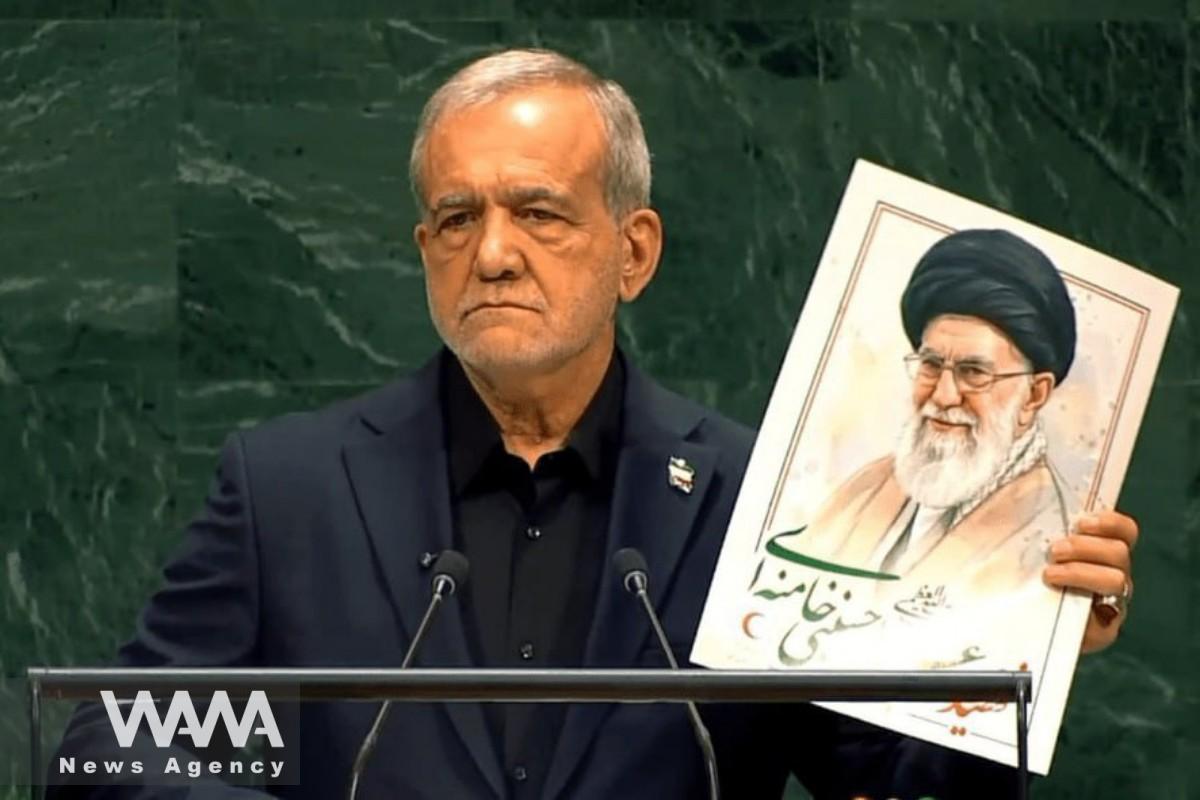
Pezeshkian at UN: Iran Cannot Be Forced to Surrender Through War
WANA (Sep 23) – Iranian President Masoud Pezeshkian told the 81st United Nations General Assembly that Iran cannot be forced to surrender through war, stressing that Tehran has never initiated a war and remains committed to negotiations, while also making clear that it is not afraid to defend itself. Pezeshkian opened his speech by […]
Iran Says IAEA Chief Must Address Past Conduct Before New Inspections
Commenting on IAEA Director General Rafael Grossi’s remarks about the conditions under which Iran might agree to renewed inspections, Baghaei said the issue had not yet reached that stage.
He said Grossi had outstanding obligations to Iran, particularly for failing to take a position after the US and Israeli regime’s attacks on Iranian nuclear facilities and for issuing ambiguous reports that, in Baghaei’s view, helped justify those actions.
He said the credibility of the International Atomic Energy Agency had been seriously damaged since then and held Grossi directly responsible. Iran was currently exchanging messages through mediators to advance its demands, he added, saying further steps depended on the United States implementing Iran’s conditions.
No Discussion of Transferring Enriched Uranium in Doha
Baghaei rejected reports that Iran might agree to transfer its 60-percent-enriched uranium to a third country as part of an agreement, saying the issue had not been raised during talks in Doha.
Asked why Washington had failed to build consensus against Iran at the G20 meeting, he said the United States either did not understand the basics of diplomacy or had forgotten them. He added that the international community had recognized Washington’s reliance on unilateralism and excessive use of force to impose its narrow interests, and was therefore unwilling to support its approach.
On the Strait of Hormuz, Baghaei said the United States and the Israeli regime were responsible for the disruption of shipping in the waterway, a fact that even Washington’s allies could not ignore. He said growing international anger over US conduct was evident at meetings such as the G20.
Debate Over Iran’s Nuclear Doctrine Reflects Public Concerns
Asked about calls in the media and public for Iran to change its nuclear doctrine and their possible impact on negotiations, Baghaei said the other side was aware of discussions among the public, intellectuals and media, and that there was no need to artificially dismiss them.
He said developments over the past two years, as well as the previous 12 to 13 years since negotiations began and led to the 2015 nuclear agreement, had prompted legitimate questions among Iranians. Despite Iran’s efforts to demonstrate the peaceful nature of its nuclear program, he said, the other side had continued to raise pretexts and had even assassinated the person who had issued the religious decree prohibiting the production and use of nuclear weapons. (referring to Iran’s late supreme leader)

Iranian Public Demand for Nuclear Doctrine Review Grows; NPT Withdrawal Debate Intensifies
WANA (Oct 31) – Hojjatoleslam Haj Ali Akbari, Tehran’s interim Friday prayer leader, referring to the growing public demand for a review of Iran’s nuclear doctrine, said: “The demand for a review of the country’s nuclear doctrine is not a hasty or emotional reaction; rather, it stems from the Iranian nation’s awareness in the face […]
Baghaei said the United States and the Israeli regime were responsible for creating and fueling debate over a possible change in Iran’s nuclear doctrine, both inside the country and internationally.
He reiterated that Iran’s nuclear program had always been peaceful and that this had been repeatedly demonstrated. He said the continued allegations of an Iranian nuclear weapons program, which he described as a major lie dating back 20 years, had reinforced the perception that evidence of the program’s peaceful nature was being deliberately disregarded.
However, Baghaei stressed that Iran remained a member of the Nuclear Non-Proliferation Treaty (NPT) and would continue to observe its obligations as long as it remained a party to the treaty.
Baghaei Says He Has Not Heard of Saudi Economic Incentives
Asked about reports that Saudi Arabia was seeking to encourage Iran to reach an agreement with the United States through economic incentives and security proposals, Baghaei said he had not heard of such an offer and that the issues were more complicated than that.
Asked how Iran was following the US midterm elections and whether their outcome could ease or intensify military tensions, he replied that Iran was following them through television.
He said, however, that the election outcome was not what mattered to Tehran; Iran’s national security and interests remained its priority. A single election would not produce a new United States, he said, noting that US hostility toward Iran dated back more than 70 years to the August 19, 1953 coup. Having witnessed repeated changes of administrations, Iran preferred to focus on itself and strengthening its capabilities across all fields.
Iran Warns Against Israeli Regime’s Role in Somalia
Commenting on the Israeli regime’s recognition of Somaliland and its appointment of an ambassador to the region, Baghaei said the regime, which he described as illegitimate and founded on the occupation of another people’s land, was seeking allies and trying to deepen divisions among regional and Islamic countries.
He said Somalia, as the internationally recognized state, had strongly protested the move, as had the Arab League, African Union, Organization of Islamic Cooperation and several Western and European countries. These reactions reflected concerns that the move could undermine peace and security in the region.
Baghaei urged Islamic and African countries to remain vigilant against what he described as the Israeli regime’s attempts to sow discord and further threaten regional stability.

Iran Says US Must Lift Post-Islamabad Sanctions and Release Frozen Assets
Asked whether Iran was demanding the removal of all sanctions and the release of all frozen financial assets in negotiations, Baghaei said the current talks should not be viewed separately from those that led to the Islamabad understanding. He said the negotiating party, Iran’s demands and the underlying dispute remained unchanged.
He said Iran’s demands were those previously accepted by the United States under the Islamabad understanding but subsequently violated. As a first step, Washington must lift all sanctions imposed under what Baghaei called the economic expulsion operation after breaching the understanding, as well as fulfill its previous commitments, including the release of Iran’s funds and assets.
He rejected the characterization of these demands as preconditions for diplomacy, saying they were necessary steps to restore security in the Strait of Hormuz and the Persian Gulf. Iran was seeking the restoration of rights that had been violated, he added, and further steps could be discussed afterward.
Asked whether a possible Democratic victory in the US elections could lead Iran to shorten its seven-day plan to two days, Baghaei said Iran did not tie decisions concerning its national security and interests to developments elsewhere in the world. Tehran made decisions based on its own interests, he said, adding that diplomacy and defense were instruments for safeguarding those interests. Iran had never sought war and would decide on the manner, timing and form of its actions after considering all relevant factors.
Any Attack on Iran Will Face Immediate and Comprehensive Response
Asked whether a possible US attack using powerful bombs against the Mount Kolang (Pickaxe Mountain) facility would cross Iran’s red line and be treated as a major nuclear war, Baghaei said any act of aggression against Iran, regardless of the means used, would face a powerful, immediate and comprehensive response.
He said the nature and form of that response would be determined by Iran’s defenders and the authorities responsible for such decisions, adding that the necessary preparations had been made.

US Seeking to Disrupt Iran’s Relations With Neighbors
Commenting on an Iraqi lawmaker’s statement that the closure of Iraq’s borders with Iran was not an independent decision but had resulted from US pressure and threats, Baghaei said Washington was using every available means to undermine Iran’s relations with neighboring countries.
He said one clear objective of such measures was to disrupt friendly ties between Iran and its neighbors, but stressed that the United States could not sever the deep bonds between their peoples.
Baghaei said Iran would make every effort to prevent outside powers from disrupting economic, trade and people-to-people exchanges with neighboring countries. Regional governments, he added, understood the importance of preserving these ties.
Iran and its neighbors would remain alongside one another permanently, he said, while the United States came and went and pursued different policies.
Baghaei: There Is Absolutely No Trust Between Iran and US
Iranian Foreign Ministry Spokesman Esmaeil Baghaei said the fundamental disagreement between Iran and the United States stemmed from Washington’s approach, stressing that there is absolutely no trust between the two sides.
Baghaei said the United States first needed to demonstrate that it genuinely accepted and was committed to diplomacy. He said Washington had repeatedly undermined diplomatic efforts, making any dialogue difficult, as every interaction required at least a minimum level of trust.
He said such trust meant having reasonable confidence that the other side would not tear up its commitments two or three weeks after signing them, adding that this confidence did not exist in Iran-US relations.

Iran Has Yet to Respond to Vance’s Letter, Reaffirms Seven Conditions
WANA (Oct 29) – Iran has not yet responded to a letter reportedly sent by U.S. Vice President JD Vance to Mohsen Rezaei, secretary of Iran’s Supreme National Security Council, and continues to insist that Washington meet its seven conditions. Information obtained by a reporter indicates that the letter has been received by the […]
Baghaei said the United States had violated Iranians’ fundamental rights by imposing new sanctions over the past four or five months and enforcing what it described as a blockade against Iran. These measures had to be lifted, he said, adding that Washington could not maintain such entirely unlawful actions while expecting Iran to move on to negotiations over other issues.
He stressed that progress depended entirely on the United States reconsidering its approach to diplomacy. Iran had not yet reached the stage of discussing the nuclear issue, he said, because it would be unreasonable to negotiate other matters before Iran’s demands were met.
Baghaei Welcomes Omani Sultan’s Visit to China
Commenting on the Omani Sultan’s visit to China, Baghaei described it as a positive bilateral initiative, saying exchanges between friendly countries were beneficial.
He said Oman had consistently worked to promote peace and stability in the region, expressing regret that its mediation efforts had been met with ingratitude by the United States. He added that dialogue between Oman and China was important, given their shared interests in maintaining stability and security in West Asia, the Persian Gulf and the Strait of Hormuz.
Iran Says Regional Countries Must Prevent Use of Their Territory Against It
Responding to a question from the public about whether southern Persian Gulf countries had guaranteed that their territory and facilities would not again be used against Iran, as happened during the 40-day war, Baghaei said countries whose territory and facilities had reportedly been used in attacks against Iran had denied this and complained about Iranian defensive strikes hitting their territory.
He said Iran had repeatedly emphasized that its defensive actions should not be interpreted as attacks against those countries.
Baghaei added that if these countries argued they had no control over US military bases on their territory, this meant they had, for whatever reason, relinquished part of their national sovereignty. They should therefore also accept that Iran’s defensive response was not directed against their territory, he said.

Rezaei: Tehran Meeting Shows U.S. Threats Have Not Hindered Regional Cooperation
WANA (Oct 26) – Major General Mohsen Rezaei, Secretary of Iran’s Supreme National Security Council, said the participation of senior officials from Pakistan, Turkey and Saudi Arabia in a four-way meeting in Tehran demonstrated that U.S. threats had not significantly affected regional relations and cooperation. Speaking after the meeting between Iran, Pakistan, Turkey and […]
He expressed hope that all parties had learned from developments over the past eight months, stressing that Iran did not want its defensive strikes to target regional countries. However, when aggressors used their facilities and military bases to attack Iran, kill Iranian citizens and strike schools and hospitals, the Iranian government had a duty to act against those threats.
Baghaei stressed that Iran’s actions were entirely defensive and based on Article 51 of the UN Charter. He said Tehran hoped that, if the aggressors sought to launch another attack, neighboring countries would not allow them to use their territory, airspace or waters. Otherwise, Iran was entitled to defend itself.
Baghaei Condemns International Silence on Israeli Threats Against Iran
Asked about the Israeli prime minister’s latest threats against Iran, in which he framed the conflict as a matter of the survival of one side or the other, Baghaei said international organizations had already been tested by previous developments and had failed to meet expectations again in recent events.
He described the selective response to such threats as regrettable, agreeing that international organizations, the UN secretary-general and European countries should address explicit threats against a UN member state.







