How American Bombs Opened the Eyes of Iran’s New Generation

WANA (Sep 09) – Nighttime, the bright lights of a small room in Tehran, and a young Iranian boy hugging his knees. On his wall, sleek, glowing posters of “Captain America” and “Superman” catch the eye—indestructible superheroes that years of shows, animations, and video games had taught him to see as symbols of absolute good from a land where saviors always emerge to rescue the world from darkness.
To him and his peers, America across the border was a dreamlike country: a flawless world that would never harm innocent people.
Time and again on television or in the streets, he had heard elders shouting “Death to America” and “Death to Colonialism,” but in his innocent young heart, there was always a big question mark:
“Why should we hate a country with so many lovely, wonderful heroes?” His childhood world knew America through promises, attractive technology, and masked heroes—not through darkness and war.

Yet sometimes, naked reality strikes like lightning, shattering fragile glass dreams. Everything changed on that day—a day when a massive explosion shook the sky.
One of Iran’s refineries was engulfed in flames and black smoke during recent aggression and strikes. High above, the sky was no longer blue; it was red and smelled of gunpowder. At the heart of that fiery inferno stood a father who had neither a cape nor superpowers.
He was a simple firefighter in a flame-resistant suit, his face hidden under a layer of smoke and ash—a man who knew these might be the final minutes of his life, and that he might never return home.
Amidst the roaring fire and flames that swallowed everything alive, the father pulled out his mobile phone. He took off his heavy safety helmet, breathless from the unbearable heat, yet his eyes held a deep, bitter awareness.

Minab: From the Schoolyard to the Rows of Graves
WANA (May 23) – As dusk falls, Minab slowly takes on a different face. Until just a few weeks ago, the sound of school bells and the lively noise of children formed part of the city’s daily rhythm. Now, every evening, the town sinks into a heavy silence. On land that was once a […]
He turned to the camera to record a message and a final wish for his twelve-year-old daughter, “Armita”—a girl who, until yesterday, like many of her peers, trusted America and could not believe that sleek superpower would harm the ordinary people of her country.
With a lump in his throat but a steady voice, the father said: “Armita, my child, this is what I was telling you about; THIS is America!”
That single sentence was the final blow to all the sold dreams.
Armita, along with all the teenagers and youths who saw that video, woke up in an instant from their Hollywood slumber. Armita no longer needed to read history books or listen to long lectures; she saw the truth of America not on the wide cinema screen, but in the smoke-stained face of her father and the fire of her country’s ruined refinery.

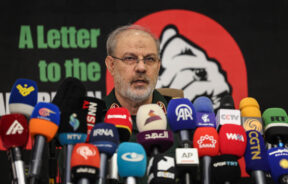
People take part in an anti-U.S. and anti-Israel rally, amid a ceasefire between U.S. and Iran, in Tehran, Iran, April 19, 2026. Majid Asgaripour/WANA (West Asia News Agency)
The image of fictional superheroes was shattered into ashes forever. Iran’s new generation learned through these strikes and flames that:
Real heroes are fathers who risk their lives against genuine atrocities, not masked cinematic characters.
The slogan “Death to Colonialism” is not a prejudice of the past, but the product of a bitter, real experience of betrayal and aggression by the United States.
The Western dream was merely a sleek mirage to hide the bombs and destruction rained down on people—and when the shadow of war falls over a country, it does not discriminate; it falls upon everyone.
Today, twelve-year-old Armitas and the youth of this land, with open and aware eyes, have become the pioneers in recognizing the enemy and rejecting the warmongering policies of the United States and Israel. They have realized that there is no outside savior, and that they alone are the ones who must stand for this land.