

Iran Army Spokesman: U.S. Bases in Region Suffered Severe Damage, Many Beyond Repair
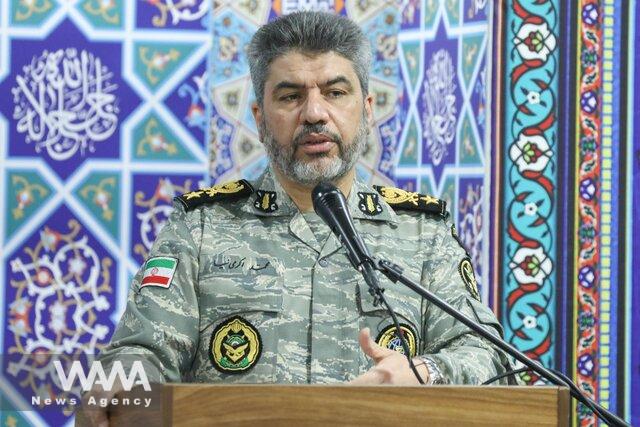
WANA (Sep 29) – Iranian Army spokesman Brigadier General Amir Akrami-Nia said U.S. forces are not in a favorable position in the region, arguing that American military bases sustained severe damage during the recent war and that many are no longer repairable.
Speaking about U.S. military movements in the region and the possibility of renewed conflict, Akrami-Nia said Iran’s armed forces had used the ceasefire period to update their target databases, upgrade military equipment, introduce new capabilities into their forces and draw on lessons learned from the recent war.
He said the purpose of these measures was to ensure that, if another attack occurs, Iran would be able to respond “better than before, more forcefully and on an even broader scale.”
U.S. Bases Face Major Damage and Logistical Challenges
Akrami-Nia said Iran’s assessment is that the United States is not in a favorable position in the region because its military bases have suffered significant damage.
He said the assessment was based on aerial and satellite imagery as well as observations on the ground. According to the Iranian Army spokesman, information available to Iran indicates that U.S. bases sustained extensive damage and that most of them can no longer be rebuilt.
He said the damage had created serious difficulties for the U.S. military’s regional logistical support, including fuel and food supplies. He specifically referred to the U.S. Fifth Fleet facility in Bahrain, saying it had suffered major damage.
Akrami-Nia said the United States had been forced to arrange some supplies from outside the region, including from East Asia and the U.S. base at Diego Garcia.
Iran Says U.S. Forces Are Under Pressure
The Iranian Army spokesman also said U.S. military personnel were facing difficult psychological conditions and referred to reported cases of suicide among American troops.
He said Washington could seek to change the current situation through a new military move, but maintained that the United States had not developed a clear strategy for ending the war.
According to Akrami-Nia, U.S. President Donald Trump had initially expected Iran’s armed forces to collapse within a short period after the war began and resistance to disappear. He said the resistance of Iran’s armed forces and public support for the government had overturned those expectations.
He pointed to changing U.S. positions on the ceasefire, continued fighting, a possible maritime blockade and the status of the Strait of Hormuz, saying the conflicting positions indicated that Washington had not developed a clear exit strategy from the war.
Iran Describes Shift Toward Pre-Emptive Operations
Discussing Iran’s military doctrine after the 12-day war, Akrami-Nia said the UN Charter prohibits the use of force except in cases of legitimate self-defense.
He said Iran had moved its military strategy toward what it describes as pre-emptive warfare following the 12-day conflict. He added that the late Army Chief Major General Seyyed Abdolrahim Mousavi had strongly pursued a shift in Iran’s defense doctrine from a defensive posture toward offensive operations.
Akrami-Nia cited attacks on the positions of opposition and separatist groups in Iraq’s Kurdistan Region as an example of this approach.
He said Iranian Army fighter jets and drones, along with missiles and drones operated by the Islamic Revolutionary Guard Corps, had targeted those positions to prevent attacks against Iran’s western borders.
The spokesman also cited Iranian strikes against U.S. bases during the subsequent period of fighting as examples of what Tehran considers pre-emptive operations.
He said such operations are conducted based on three principles: proportionality, imminence and necessity. According to Akrami-Nia, Iran would use pre-emptive operations in the future if it concludes that an enemy attack is imminent.
Iran Says U.S. Prioritizes Israel’s Security
Akrami-Nia said the recent conflict had demonstrated, in Iran’s assessment, that the United States places limited importance on the security and national interests of regional countries.
He said Washington’s priority in the region was Israel’s security, attributing this to what he described as the influence of the pro-Israel lobby in U.S. political institutions.
The Iranian Army spokesman said U.S. bases across the region had sustained extensive damage and that some Western and American media outlets had also reported that several facilities would be difficult or impossible to rebuild.
He said Iran considers Arab countries in the region its “brothers” rather than rivals, while viewing Israel as an adversary of the region and the wider Muslim world.
Akrami-Nia said Iran had not targeted civilians or the infrastructure of regional countries during the conflict and that its attacks had focused on U.S. military bases. He added that, after the United States struck some Iranian infrastructure, Iran had carried out limited attacks against infrastructure belonging to American companies in the region.
Iran Says It Is Determined to Maintain Control of Strait of Hormuz
Akrami-Nia described the Strait of Hormuz as a strategically important geopolitical position for Iran and said Tehran had historically allowed commercial vessels to pass through the waterway.
He said the waterway had subsequently been used to facilitate the movement of U.S. military equipment and the establishment of American bases in regional countries.
According to the Iranian Army spokesman, Iran has now decided to prevent what it considers hostile or threatening passage through the strait and is exercising control over the waterway.
He said the number of vessels and tankers passing through Hormuz had fallen sharply compared with the period before the war. More than 130 ships, vessels and oil tankers had previously passed through the strait, he said, whereas traffic has now dropped significantly.
Akrami-Nia said Iran had reached an arrangement with Oman establishing routes for vessels entering and leaving the Persian Gulf. He said the agreement takes Omani interests into account, while accusing the United States of obstructing its implementation.
He stressed that Iran remains determined to maintain its control over the Strait of Hormuz and said Tehran was not concerned about occasional or limited passages of vessels, but intended to maintain control of the waterway over the long term.
Iran Highlights Yemen’s Position in the Red Sea
The Iranian Army spokesman also referred to Yemen’s position along the Red Sea, saying Yemeni forces now control large stretches of the coastline.
He said developments in the Red Sea could have significant geopolitical consequences and described control of the Bab al-Mandab Strait as a source of strategic and political leverage for Yemen.
Akrami-Nia said the developments could also strengthen the position of what Iran calls the “resistance front” in the region.
At the same time, he said Iran does not seek a continuation of the war and supports a political settlement between Saudi Arabia and Yemen that respects the rights of the Yemeni people.
Iran Highlights New Drone Capabilities
Discussing the Iranian Army’s drone capabilities, Akrami-Nia said Iranian drones had performed successfully during the recent conflict.
He said that after the Arash-2 drone, the Army had deployed a new drone whose specifications have not yet been made public. He added that details would be released when deemed appropriate.
The spokesman said Iran produced drones on a daily basis throughout the war and did not need to draw on its existing stockpiles. Daily production continues at several facilities, he said, while research and development efforts are focused on improving the drones’ capabilities, quality and destructive power.
Akrami-Nia also said a drone costing around $30,000 could cause significant damage to U.S. air-defense systems and military infrastructure, while the missiles used to intercept such drones could cost considerably more.
Iran Says It Is Prepared for a Prolonged Conflict
Akrami-Nia said Iran’s armed forces remain prepared for a prolonged conflict in terms of equipment, personnel, motivation and psychological readiness.
He pointed to Iran’s experience during the Iran-Iraq War as evidence of the country’s ability to sustain prolonged resistance.
The spokesman also drew parallels between the 1980 Iraqi invasion of Iran and the more recent conflict with the United States. He said Saddam Hussein had made a miscalculation in 1980 by assuming that Iran’s defense structures were weak in the aftermath of the Islamic Revolution.
Akrami-Nia said the Iranian Army had nevertheless anticipated the possibility of war and prepared defensive plans in advance.
He highlighted the Iranian Air Force’s response to Iraq’s invasion on September 22, 1980, saying Iranian aircraft struck back roughly two and a half hours after the Iraqi attack. He also referred to Operation Kaman 99, launched 24 hours after the start of the war with the participation of 140 Iranian fighter aircraft.
He said Iranian ground forces subsequently halted the Iraqi advance after around 70 days and later launched operations that led to the withdrawal of Iraqi forces from approximately 15,000 square kilometers of occupied Iranian territory.
Akrami-Nia said a similar miscalculation had been made by the Trump administration, which, in his assessment, viewed Iran as weakened by regional developments and therefore vulnerable to attack.
He said Iran’s armed forces responded with missiles and drones approximately two hours after the U.S. attack began, arguing that the response demonstrated that Iran had not been caught unprepared.







