Qaani: US Was Expelled from Iraq and Defeated in Iran

WANA (Oct 02) – IRGC Quds Force Commander Brig. Gen. Esmail Qaani said the United States had been expelled from Iraq and had also suffered defeat in its confrontation with Iran, while emphasizing what he described as the continued strength and expansion of resistance forces across the region.
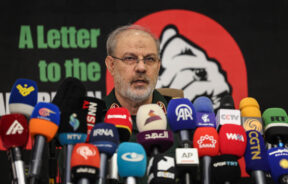
Speaking at a ceremony in Tehran commemorating late Hezbollah Secretary-General Hassan Nasrallah, Hashem Safieddine and Abbas Nilforoushan, Qaani said the United States had been expelled from Iraq and that the Iraqi people were celebrating the development, which he attributed to the resistance of the Iraqi people and the resistance front.
He said the process should continue until all remaining traces of U.S. presence in Iraq were removed, stressing that the United States should be expelled from both the ground and air of the country. Qaani said Iraqi and resistance forces remained prepared to confront any continued U.S. presence, adding that Washington was seeking to reduce the significance of its expulsion by raising other issues, including air traffic.
On Iran, Qaani said the United States had entered the confrontation believing it could force Iran to surrender within four days or, at most, two weeks. He said the outcome had instead been a humiliating one for Washington, arguing that the United States had failed to achieve its objectives against Iran.
Turning to Lebanon, Qaani said Hezbollah had faced one of the most difficult periods in its history but had continued fighting despite the killing of Nasrallah, Safieddine and a number of its senior commanders. He said the group had inflicted heavy losses on Israel and argued that the scale of Israeli casualties during the conflict was greater than in any previous period, adding that the full extent of those losses would become clearer over time.
Qaani said Hezbollah had carried out 9,550 operations during the conflict. He claimed that around one-third of Israeli military equipment had been destroyed, while another third had been damaged or withdrawn from the battlefield.
He also said 450 vehicles and related military equipment had been hit. According to Qaani, the losses suffered by Hezbollah’s senior command led to the emergence of a new generation of commanders and fighters, while the group had remained capable of continuing its operations.
On Palestine, Qaani said the Islamic Republic had not abandoned its allies or what he described as oppressed peoples during the conflict and would continue to support them. Referring to recent arrangements concerning Gaza, he said Palestinians had acted within the framework of the agreements while Israel had once again violated its commitments.
He warned Israeli leaders against assuming that what he described as their recent gains would continue, saying that the Palestinian territories would ultimately return to their people and original owners. He also said Israel should accept defeat and leave the occupied territories, warning that resistance forces would ultimately force such an outcome.
Regarding Yemen, Qaani called for an end to the war and blockade against the country, addressing Saudi officials by saying that they were familiar with the Yemeni people and that ending the conflict would be in Saudi Arabia’s interests. He questioned the continuation of military spending against Yemen and said Muslim countries should instead concentrate their resources on helping one another and ending conflicts in the region.
Qaani also called on Persian Gulf countries to strengthen unity based on Islam and resolve regional issues through cooperation with Iran and among themselves. He argued that Persian Gulf states should reconsider their reliance on the United States, saying Washington had promised to protect them but had failed to do so, and urged them to cooperate with neighboring Muslim countries.
On the broader regional situation, Qaani said the resistance front was operating under difficult circumstances but was continuing to expand its capabilities. Referring to Yemen, he said the Yemeni movement had achieved recent battlefield successes despite more than a decade of blockade and claimed that its forces had seized more than 5,400 square kilometers in an earlier operation and were currently taking control of more than 1,000 additional square kilometers.
Qaani further argued that developments in Iraq, Lebanon, Palestine and Yemen demonstrated the continued role of resistance forces in regional affairs, and called for greater coordination among Muslim countries in confronting what he described as U.S. and Israeli aggression.