Rezaei: Iran to Establish New Restricted Zone in Persian Gulf

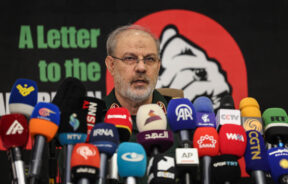
WANA (Sep 06) – Iran’s Secretary of the Supreme National Security Council, Mohsen Rezaei, has announced a shift in Tehran’s strategy regarding the war, diplomacy and efforts to counter the US blockade, saying Iran will establish a new restricted zone in the Persian Gulf and Gulf of Oman in the coming days.
Rezaei said any vessel operating on either side of the Strait of Hormuz and attempting to head toward the strait without coordination with Iran would be placed on Iran’s sanctions list.
New Restricted Zone to Cover Area Near US Blockade Line pool
Rezaei, who also serves as the representative of Iran’s Supreme Leader on the Supreme National Security Council, said Iran decided to adopt new strategies in the areas of military operations, negotiations and countering the blockade after reviewing developments over the past year and following US President Donald Trump’s withdrawal from the Islamabad understanding.
He said the new restricted zone would cover the area between the US blockade line and loading ports.
According to Rezaei, vessels entering the area and attempting to proceed toward the Strait of Hormuz without coordinating with Iran would face Iranian sanctions. He said such measures could result in difficulties with insurance coverage and future navigation and transit.
Rezaei described the move as one of the first major changes in Iran’s approach to the Strait of Hormuz and said it would increase pressure on the United States.

Vessels in the Strait of Hormuz are visible near the beach of Bandar Abbas, Iran, August 26, 2026. Majid Asgaripour/WANA (West Asia News Agency)
Rezaei: Strait of Hormuz Is Fully Closed
Rezaei said the Strait of Hormuz is “completely closed,” rejecting US statements that ships and oil tankers are continuing to pass through the strategic waterway.
He said some vessels have attempted to use a rocky route near Oman, with some allegedly switching off their navigation systems while trying to pass through the area. According to Rezaei, many of these vessels have sustained damage.
He added that Iran has so far refrained from sinking such vessels because of environmental concerns.
Rezaei reiterated that the Strait of Hormuz would remain closed until the other side takes practical action.
Iran Activating Land Corridors and New Route With Oman
Rezaei said Iran is also changing its approach to foreign trade as part of efforts to counter the maritime blockade.
He noted that Iran has 15 neighboring countries and argued that a country with such a geographic position should not rely solely on maritime trade. He said land-based trade corridors are therefore being activated.
Rezaei also announced the establishment of a new international corridor involving Iran and Oman in the Strait of Hormuz. He said the route had been agreed upon with Oman and would be managed by Iran, with further details expected to be announced in the coming days.

Iran’s New Tactic to Wear Down the US
WANA (Sep 06) – Recent clashes indicate that Iran is changing part of its operational approach, with three key features emerging: preemptive strikes, targeted casualty-inflicting operations, and efforts to restrict maritime traffic. Brigadier General Mohammad Akrami-Nia, a spokesman for Iran’s Army, has said that Iran’s military doctrine has shifted toward the use of “preemptive […]
Rezaei: US Blockade Will Not Cause Shortages
The Iranian official rejected suggestions that the US blockade would lead to shortages or famine in Iran, saying the government had made preparations in advance.
According to Rezaei, Iran’s stocks of essential goods are secure and stable. He also said that during the period covered by the Islamabad understanding, Iran had moved approximately 70 to 80 million barrels of previously produced and stored oil out of the region and was currently selling it.
Attack on US Warship Was a Warning, Rezaei Says
Rezaei also referred to what he described as a “major warning attack” on a US warship approximately 48 hours earlier.
He said the attack was significant enough that US Central Command, or CENTCOM, could not conceal it, describing the incident as a warning that the US maritime blockade is vulnerable.
He also cited Iranian attacks on US positions in Jordan and Erbil as part of what he described as a shift in Iran’s military strategy.
Diplomacy Has Not Ended, but Iran Wants Practical US Action
Rezaei stressed that Iran’s new approach does not mean diplomacy has been abandoned. However, he said Tehran would no longer rely solely on promises or guarantees from mediators.
He said Iran had sought guarantees under the Islamabad understanding but concluded that even the mediating parties were unable to provide the assurances Tehran wanted.
Under the new approach, he said, Iran would wait for practical steps from the United States before taking action of its own.
Rezaei described Iran’s distrust of the United States as rooted in the history of bilateral relations, citing the 1953 coup in Iran and subsequent developments. He said Iran had legitimate reasons to distrust Washington, while arguing that Iran’s record on confidence-building was clear.
He added that, in Iran’s view, Washington’s definition of “trust” effectively means having Iran serve US interests.

How Can Iran Make America Pay a Higher Price for Economic Warfare?
WANA (Sep 05) – After Washington failed to achieve its desired objectives quickly through military force, the United States is now placing greater emphasis on economic pressure and blockade. The logic behind this shift is straightforward: if military confrontation comes at a high cost, Washington can turn to an instrument that appears, at least on […]
Rezaei: US War Plans Failed
Rezaei said US President Donald Trump had initially spoken of plans for a heavy 10-day military campaign against Iran. However, he said that after Iran launched surprise attacks against US support bases and troop positions in Jordan and Erbil, the planned campaign effectively ended on its first day.
He also referred to the testing of an anti-ship missile near a US warship, describing it as another factor that forced US forces to withdraw.
Rezaei said Iran was not seeking war but was standing against what he described as US warmongering. He said Tehran wanted an end to conflicts across the region, including in Gaza, Lebanon, Syria and Iran.
Iran Warns of Attempts to Create Internal Unrest
The secretary of the Supreme National Security Council also accused the United States and Israel of shifting their focus toward creating instability inside Iran after failing to build an international coalition against Tehran.
According to Rezaei, Israeli Prime Minister Benjamin Netanyahu is seeking to persuade Trump to focus on unrest inside Iran and create conditions similar to what Rezaei called the “December coup,” while simultaneously preparing for a military attack.
He said such a strategy would also fail, citing public support and Iran’s experience during recent confrontations with the United States.

Trump’s Carter Nightmare Comes True
WANA (Aug 31) – For years, Donald Trump portrayed former U.S. President Jimmy Carter as a symbol of weakness in foreign policy and economic failure, repeatedly insisting that he did not want to repeat Carter’s fate. Now, several months into the war with Iran, some American media outlets and analysts are drawing parallels between Trump’s […]
Rezaei: Hezbollah and Lebanon Will Ultimately Prevail
Addressing developments in Lebanon and what Iran describes as efforts by Israel to undermine the “unity of fronts,” Rezaei said no war has historically been characterized by continuous victories or continuous defeats.
He said that over the past three decades, Hezbollah had generally maintained the upper hand despite periods of setbacks and fluctuations.
“Lebanon and Hezbollah will ultimately prevail,” Rezaei said.
He also stressed that Iran retains what he described as its right to retaliate over a US attack on a wedding ceremony in Sirik.
Rezaei Rejects Netanyahu’s Remarks on Iran
Responding to Israeli Prime Minister Benjamin Netanyahu’s assertion that Iran has been deterred from attacking Israel because of Israel’s military strength, Rezaei dismissed the remarks as political rhetoric.
He said Netanyahu’s statements were largely motivated by electoral considerations and that Iran would continue pursuing its plans.

A woman walks on a street in Tehran, Iran, September 2, 2026. Majid Asgaripour/WANA (West Asia News Agency)
Call for Unity and Rejection of Internal Divisions
Rezaei also addressed the recent remarks by Iran’s Supreme Leader concerning what he called “false dichotomies,” describing the term as an accurate characterization of attempts to create artificial divisions.
He warned Iranian officials against becoming caught up in divisive political narratives, saying adversaries could exploit internal disagreements.
Rezaei referred to historical episodes including the Constitutional Revolution and the nationalization of Iran’s oil industry, as well as developments following the 1979 Islamic Revolution, arguing that internal divisions had repeatedly been exploited by Iran’s adversaries.
He called for greater cooperation between those advocating resistance and those emphasizing national unity, urging political groups to show greater tolerance toward one another.
Rezaei also criticized statements suggesting that the Strait of Hormuz should not become a “strait of war,” saying it currently represents Iran’s “strait of dignity.” He argued that Iran’s experience over the past two centuries showed that whenever the country retreated, its adversaries advanced.
Iran Working on Economic Security Plan
Rezaei said the Supreme National Security Council is drafting an economic security document aimed at helping attract foreign investment and providing a clearer economic outlook for young Iranians.
He also defended his proposal to turn every Iranian household into an economic production unit, citing China, Malaysia and Taiwan as examples of countries where similar approaches have been implemented.
According to Rezaei, Iran has the capacity to produce goods for distribution across the region and on global markets.
Rezaei concluded by calling on the Iranian people to support the country’s armed forces, saying they were defending Iran, its people and the country’s standing and dignity internationally.