U.S.-Israel Plan to Fuel Unrest Inside Iran

WANA (Sep 28) – The United States and Israel are reportedly considering a strategy aimed at increasing pressure on Iran through a combination of internal unrest, economic and security pressure, and renewed military threats.
The scenario comes amid growing tensions between Tehran and Washington and follows recent remarks by U.S. President Donald Trump, who did not rule out the possibility of another attack on Iran before the U.S. midterm elections, saying he did not want to discuss the matter.
1. The United States and Israel have reportedly concluded that a new wave of unrest must be triggered in Iran.
2. The two countries believe that renewed domestic unrest would provide an opportunity to launch another military strike against Iran.

Starlink: Netanyahu’s Gift to Iran
WANA (Sep 25) – Yesterday, during his speech at the United Nations General Assembly, Israeli Prime Minister Benjamin Netanyahu held up a Starlink device and urged the Iranian people to use it to bypass internet restrictions. A few minutes later, Israel’s Ambassador to the UN, Danny Danon, carried the same device toward the Iranian […]
3. Iran’s political divisions and economic conditions are seen by its adversaries as the main drivers that could fuel new unrest.
4. The United States and Israel are reportedly seeking to encourage armed activity along Iran’s borders and inside the country, followed by nationwide unrest based on the pattern witnessed on January 8.
5. The United States and Israel consider unity among Iranian officials and people’s presence in the streets to be the main factors preventing unrest from taking hold.
6. Israel has reportedly instructed its operatives on social media to create divisions and drive people away from the streets.
7. The United States and Israel believe that intensified restrictions on Iran’s airspace have had a psychological impact on parts of Iranian society beyond their direct effects, potentially preparing them for unrest.
8. Iran’s judiciary has begun taking action against individuals accused of undermining social cohesion.

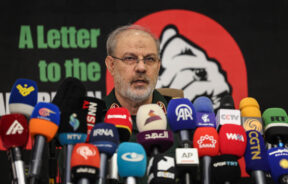
Female members of Iranian militia forces (Basij) carry a banner against U.S. President Donald Trump during a military march in Tehran, Iran, September 18, 2026. Majid Asgaripour/WANA (West Asia News Agency)
Latest Threats Against Iran
1. The United States has rejected Iran’s seven-day proposal for reopening the Strait of Hormuz.
2. Under the proposal, Iran offered to return to the Islamabad understanding and called for the lifting of sanctions, without including the nuclear issue in the discussions.
3. The rejection of Iran’s proposal has increased concerns over the possibility of further threats or military action.
4. The assassination of officials and attacks on nuclear, military and security facilities could potentially be among the measures under consideration by Iran’s adversaries.

One-Line Summary of the U.S. President’s UN Speech: Trump Caught Up in the War with Iran
WANA (Sep 22) – Donald Trump’s speech at the 81st session of the United Nations General Assembly focused more than anything else on the war with Iran and on defending Washington’s decision to enter the conflict. A significant portion of the U.S. president’s remarks was devoted to explaining the reasons for launching the war, Washington’s […]
Meanwhile, Trump’s latest remarks about the possibility of another attack on Iran have added to concerns over a renewed military confrontation. Asked whether attacks on Iran before the U.S. midterm elections were still on the table, Trump said he did not want to discuss the issue but acknowledged that such an action remained possible.
Trump also said the United States was already winning from a military standpoint, while stressing that this did not mean Washington had stopped taking action.
He has further described economic warfare and military action as two avenues through which the United States could achieve its objectives, saying Washington would prevail through both approaches. His remarks come as economic pressure and restrictions on Iran continue alongside military and security threats.
At the regional level, reports have also emerged about a lengthy meeting between Israeli Prime Minister Benjamin Netanyahu and the president of the United Arab Emirates in Abu Dhabi. An Israeli television channel reported that the meeting lasted around six hours and focused primarily on a possible future war with Iran. The claim has not been independently verified.
Trump’s recent remarks at the United Nations also reflected Washington’s broader position toward Iran. In his address, the U.S. president repeated a number of accusations and positions previously voiced by Washington concerning Iran, including its nuclear program, military capabilities and regional role.
Taken together, these developments point to continued pressure on Iran across several fronts, including economic, political, security and military dimensions. At the same time, claims about a specific coordinated U.S.-Israeli plan to trigger internal unrest in Iran would require independent confirmation.