Where Does Safe Passage End for Violating Vessels in the Persian Gulf?

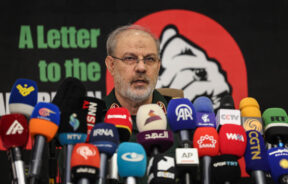
WANA (Sep 07) – Ali Mohammadi, political deputy of the Islamic Revolutionary Guard Corps (IRGC) Navy, said vessels leaving the Persian Gulf would no longer be considered safe from possible strikes after passing the area near Oman’s Khasab port if they violated Iran’s maritime rules.
Mohammadi said the IRGC Navy was maintaining continuous intelligence and operational surveillance over vessels across the Persian Gulf, Strait of Hormuz and Gulf of Oman.
He said that from nightfall until dawn, safe passage through what he called the “American corridor” south of the Strait was effectively impossible.
Vessels entering that corridor would, upon reaching the Khasab area, no longer be protected from the risk of being struck, although they remained under IRGC surveillance before reaching that point.

Iran Sets Rules for Strait of Hormuz Transit
Mohammadi said vessels seeking safe passage through the Strait of Hormuz must use the corridor designated by Iran, which he said had also been registered with the International Maritime Organization.
He added that ships were required to follow Iran’s announced procedures for transit. Those failing to do so would be identified as violating vessels and would face action.
IRGC Official Accuses US of Challenging Iran’s Control
Mohammadi said the United States had violated the Islamabad memorandum from the outset because it could not accept Iran influencing a corridor that Washington had intended to demonstrate its own ability to manage the Strait of Hormuz.
He said the US had attempted to disrupt regional arrangements to restore its preferred corridor as a secure and reliable route, but had ultimately failed in the face of Iran’s ability to impose its will in the area.

IRGC Navy Commander: Vessels Violating the Strait of Hormuz Restrictions Will Be Targeted
WANA (Sep 06) – The commander of the Islamic Revolutionary Guard Corps (IRGC) Navy said that following the U.S. attack on three Iranian oil tankers in the Strait of Hormuz, IRGC forces responded by targeting three oil tankers traveling through unauthorized routes in the strait, as well as three U.S.-affiliated vessels in other locations. […]
According to Mohammadi, the issue had now gone beyond a dispute over shipping routes and had become a challenge to US credibility and capabilities. He described recent US involvement in the conflict as an attempt to change what he characterized as a situation of defeat and humiliation.
Attacks on Vessels
The United States had recently attempted to alter the military balance in the Strait by targeting Iranian vessels, prompting a response from Iran’s armed forces.
The IRGC Navy subsequently said it had attacked three oil tankers using an unauthorized route through the Strait, as well as three US-linked vessels and a remotely operated unmanned vessel belonging to the US military that had allegedly attempted to enter the Strait’s protected zone.
Iran Plans to Announce New Restricted Zone
Meanwhile, Mohsen Rezaei, secretary of Iran’s Supreme National Security Council, said a new restricted maritime zone outside the Strait of Hormuz would be announced in the coming days.
He said the zone would begin from the area of the US naval blockade and extend into parts of the Persian Gulf. Any vessel entering the newly designated area without Iranian permission in an attempt to transit the Strait would reportedly be placed on a sanctions list.

Rezaei: Iran to Establish New Restricted Zone in Persian Gulf
WANA (Sep 06) – Iran’s Secretary of the Supreme National Security Council, Mohsen Rezaei, has announced a shift in Tehran’s strategy regarding the war, diplomacy and efforts to counter the US blockade, saying Iran will establish a new restricted zone in the Persian Gulf and Gulf of Oman in the coming days. Rezaei said […]