Iran at UN: We Will Not Yield to External Pressure
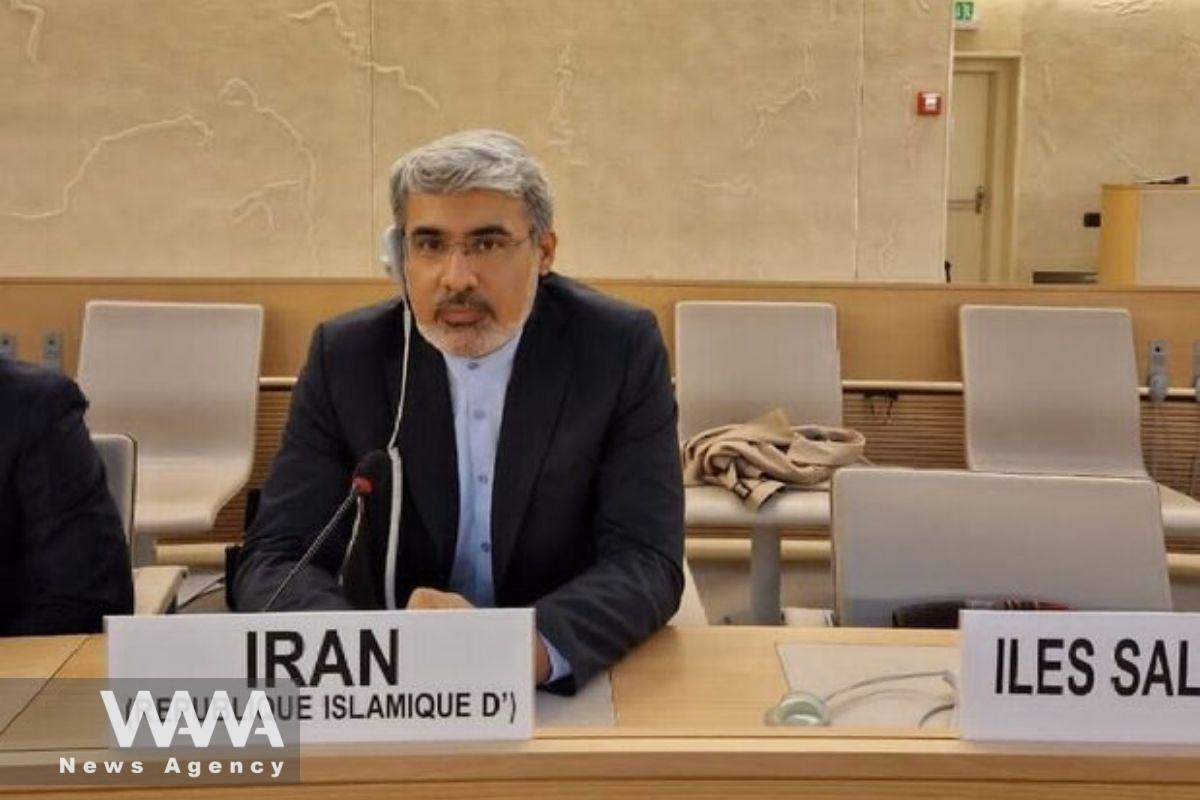
WANA (Jan 23) – Ali Bahraini, Ambassador and Permanent Representative of the Islamic Republic of Iran to the United Nations Office and other international organizations in Geneva, told a session of the UN Human Rights Council that Iran will not submit to external pressure and will not tolerate what he described as “covert aggression disguised as human rights concerns.”
Criticizing the holding of a special session on Iran, Bahraini said the organizers’ primary objective was not the genuine defense of the human rights of the Iranian people. He argued that the imposition of sweeping and inhumane sanctions—measures that directly violate the fundamental rights of Iranian citizens—stands in clear contradiction to claims of concern for human rights.
He also described some governments’ support for Israel’s military actions as an example of double standards, stressing that these actions have resulted in the killing and injury of thousands of Iranian citizens.
Bahraini further characterized the presence of certain individuals at the session—whom he said are funded by the US State Department—as additional evidence of the political nature of the meeting. He added that these individuals have no real connection to Iranian society and merely play a role within a broader framework of political pressure against Tehran.
In another part of his remarks, Bahraini addressed domestic developments in Iran, saying that since the outbreak of protests in late December 2025, the Iranian government has recognized citizens’ right to peaceful protest and activated channels for dialogue.
However, he said that at a later stage the protests were organized into violent acts, including terrorist attacks, destruction of public property, and armed actions against civilians and security forces.

People attend the funeral of the security forces who were killed in the protests erupt over the collapse of the currency’s value in Tehran, Iran, January 14, 2026. Majid Asgaripour/WANA (West Asia News Agency)
He stated that official, verified statistics on the recent unrest have been published transparently. According to these data, more than 3,000 people have lost their lives, a significant portion of whom were killed as a direct result of terrorist operations. Bahraini emphasized that these figures are the product of national investigations and legal documentation processes, not fabricated or politically motivated data.
The Iranian ambassador rejected the legitimacy of the Human Rights Council’s special session and related resolutions, saying that the Islamic Republic of Iran has independent national mechanisms to investigate violence and ensure accountability.
He also referred to recent remarks by Iran’s president, who has ordered a comprehensive review of the causes and roots of the unrest, while emphasizing the right to protest and the need to listen to the people’s voices.
Bahraini stressed that the legal status of detainees will be examined in accordance with domestic laws and in line with recognized international standards, including principles of fairness, impartiality, and transparency. Those whose criminal responsibility is established, he said, will be held accountable within the framework of the law.
In closing, referring to Iran’s historical background, Bahraini said that a nation with a civilization spanning several millennia has never accepted domination or external pressure. According to him, history shows that Iran has stood firm in the face of war, sanctions, terrorism, and sustained pressure, and that this resilience is rooted in the country’s identity, historical memory, and social cohesion.
He added that attempts by some governments with extensive records of human rights violations to “lecture” Iran are not only lacking in credibility but also reflect political hypocrisy within the international system.

The Human Toll of Iran’s Unrest
WANA (Jan 20) – 12000 killed. A figure that first surfaced on social media, then appeared in Persian-language outlets abroad, and quickly became the dominant narrative. Images circulating from Tehran’s Kahrizak forensic center showing body covers with five-digit numbers were passed around as “evidence,” reinforcing claims that Iran was facing an unprecedented wave of fatalities. […]