
Quds Day March in Tehran Held Amid Airstrikes

WANA (Mar 13) – This year’s International Quds Day march in Iran’s capital took place under extraordinary circumstances, as reports of airstrikes and explosions emerged from several parts of the city.
Despite the situation, thousands of Tehran residents gathered along the designated routes and continued the march, in scenes that observers said recalled moments from the Iran–Iraq war of the 1980s.
What is Quds Day?
International Quds Day is held every year on the last Friday of the holy month of Ramadan. It was established in 1979 by Ruhollah Khomeini, the founder of the Islamic Republic of Iran, as a day to express support for Palestinians and opposition to the policies of Israel.
Demonstrations and rallies marking the occasion are held annually across Iran and in several other countries.
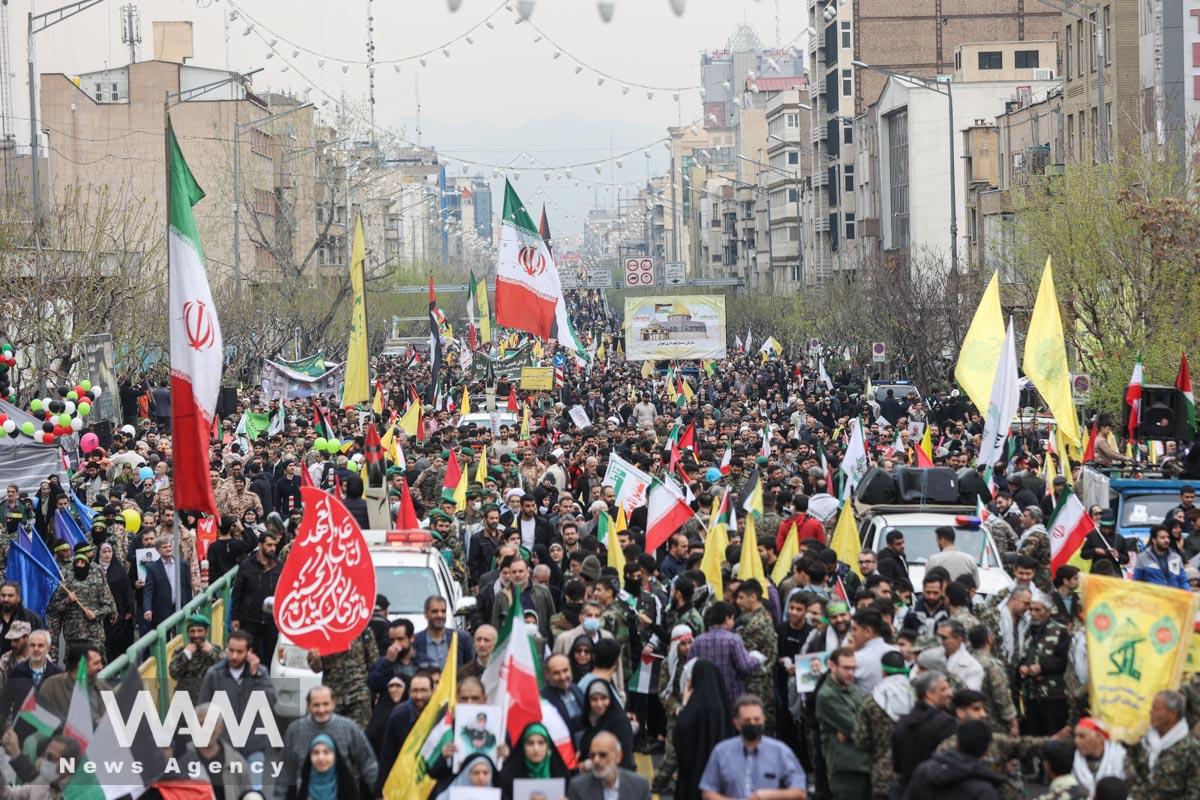
Iranians take part in a protest marking the annual al-Quds Day (Jerusalem Day) on the last Friday of the holy month of Ramadan in Tehran, Iran, March 28, 2025. Majid Asgaripour/WANA (West Asia News Agency)
Echoes of a Wartime Quds Day
Some participants compared this year’s march to Quds Day in 1985, when Iran was in the fifth year of its war with Iraq and cities were regularly subjected to bombardment.
At the time, Akbar Hashemi Rafsanjani, then Speaker of Parliament and Tehran’s interim Friday prayer leader, had called on supporters of continuing the war to attend the march carrying placards reading “War, war until victory.”
March Continues Despite Explosions
During this year’s event, witnesses reported hearing explosions in several parts of Tehran while the march was underway. Images circulating on social media showed participants continuing along the planned routes, chanting slogans even in areas near the reported blasts.
According to reports, a civilian woman was killed in one of the attacks. A photograph of the Iranian flag stained with her blood circulated widely online, becoming one of the most widely shared images of the day.

Woman Killed in Quds Day March Following U.S.-Israeli Attacks. Social media/ WANA News Agency
The international broadcaster RT published several videos from the event, reporting that the Quds Day march in Tehran continued even as explosions were heard nearby. The outlet noted that participants did not disperse and remained in the streets despite the reported attacks around the march routes.
Several senior Iranian officials were also seen among the marchers. Among them was Masoud Pezeshkian, the President of Iran, who walked part of the route among participants and interacted with members of the crowd.
Ali Larijani also commented on the attacks, describing them as a sign of “desperation” by Iran’s adversaries and stating that such actions would not deter public participation.
Meanwhile, Iran’s Foreign Minister Abbas Araghchi, who attended the march, issued a statement saying: “I proudly joined the strong and resilient people of Iran at the Quds Day march. Iranians will always stand firm and will never bow to cowardly attacks.”
He added that the reaction of the marchers during the bombing of Tehran would become “a nightmare for the aggressors.”

This year’s Quds Day rally in Tehran took place under unusually tense circumstances due to the simultaneous reports of explosions and attacks. Nevertheless, images and videos from the scene showed large crowds continuing along the designated routes until the end of the event.
Analysts say the widely shared footage of people marching despite the reported strikes has quickly become one of the defining narratives surrounding this year’s Quds Day events.